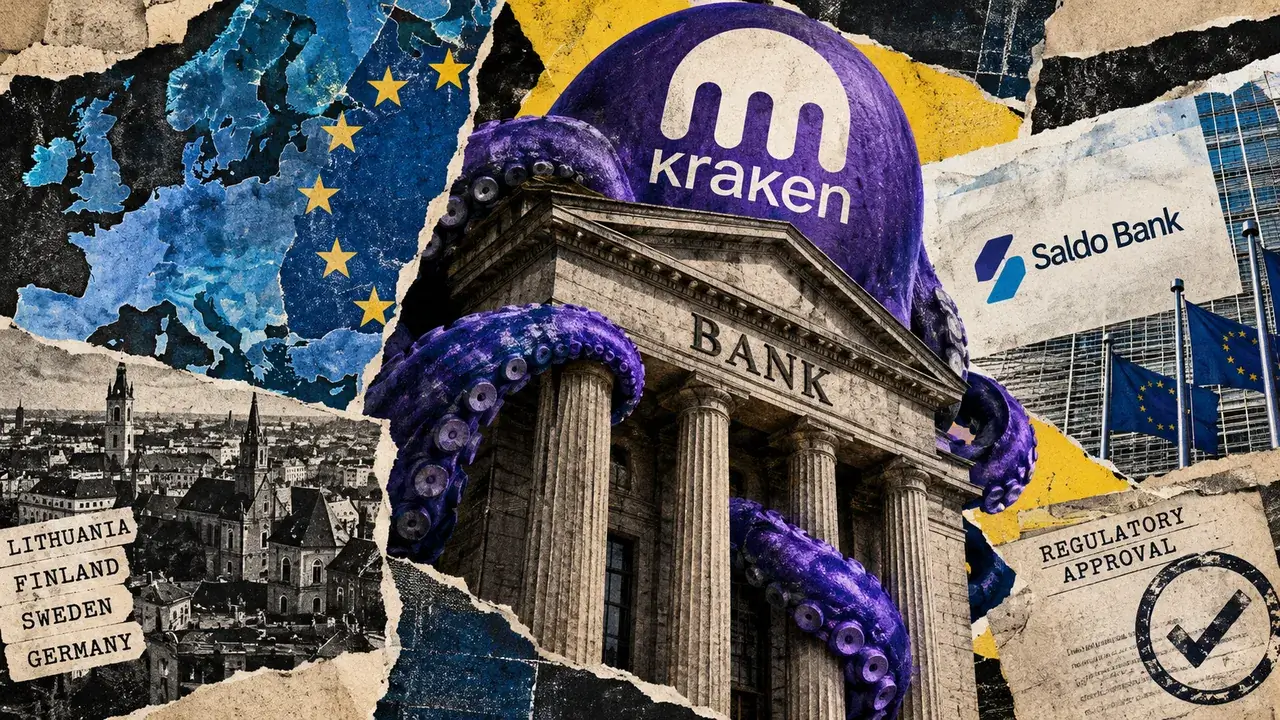
Kraken has completed the acquisition of a European bank, marking one of the most significant structural moves by a major crypto exchange to embed itself within the traditional financial regulatory framework. The deal gives Kraken a banking license that is passportable across European Union member states, allowing it to offer regulated deposit accounts, payment services, and credit products without requiring separate licensing negotiations in each jurisdiction.
The acquisition represents a strategic bet that the next phase of crypto adoption will be driven not by decentralized infrastructure alone, but by regulated entities that can interface directly with legacy banking rails. With a EU banking license in hand, Kraken gains access to SEPA payment networks, the ability to hold customer funds under deposit protection schemes, and a compliance posture that institutional clients increasingly require before allocating capital to a platform.
For years, crypto exchanges operating in Europe have relied on Electronic Money Institution licenses or payment institution registrations — frameworks that allow money transmission and custody but stop short of full banking privileges. The gap matters in practice: EMI-licensed firms cannot originate loans, cannot offer interest-bearing accounts under deposit guarantee frameworks, and face friction when large institutional clients need counterparty relationships that their own compliance teams can approve without lengthy legal analysis.
A banking license eliminates most of that friction. It signals to regulators, institutional allocators, and corporate treasury desks that Kraken is operating inside the same legal perimeter as a traditional bank — with capital adequacy requirements, regular supervisory examination, and access to central bank settlement infrastructure. For Kraken, the license is less about immediate product launches and more about removing the ceiling on what it can eventually offer to the European market.
The timing is not coincidental. The EU's Markets in Crypto-Assets regulation has been progressively reshaping the competitive dynamics for exchanges serving European clients. MiCA created a unified licensing framework for crypto asset service providers, but it did not eliminate the advantages of holding a banking license alongside a CASP authorization. Firms with both can operate in product categories — credit, deposits, payment accounts — that MiCA-only licensed entities cannot touch.
Competitors without equivalent licenses will face a structural disadvantage in competing for institutional mandates that require banking-grade counterparty status. The acquisition effectively draws a new dividing line in the European exchange market between platforms that can offer the full product stack and those that remain constrained to trading and custody.
Completing an acquisition is the beginning of a regulatory integration process, not the end of it. Banking supervisors typically impose post-acquisition conditions: capital injection timelines, systems integration milestones, fit-and-proper assessments of incoming management, and ongoing reporting requirements tied to the acquiring entity's crypto operations. The acquired bank's existing loan book, employee base, and compliance systems must be brought into alignment with Kraken's operational model — a process that can take years and carries execution risk at each step.
"Acquiring a bank license is not the same as knowing how to run a bank. The hard work starts after the ink dries." — Senior European banking regulatory consultant, October 2026
There is also the question of how banking supervisors will treat the crypto side of the combined entity. European banking regulators have historically viewed large crypto exposures as a source of reputational and operational risk, and a bank with a major crypto exchange parent will face scrutiny over intragroup transactions, liquidity management, and the extent to which crypto market volatility could transmit stress into the bank's balance sheet.
For retail and institutional users based in the EU, the acquisition creates a pathway toward a more integrated financial experience — crypto trading, euro-denominated accounts, payment services, and potentially lending products under a single regulated entity. Whether Kraken moves quickly to launch these products or prioritizes the quieter work of regulatory integration will depend on its read of the competitive urgency and supervisor expectations.
The broader implication for the crypto industry is that the gap between "crypto-native" and "bank" is narrowing. As more exchanges pursue banking licenses, payments firms, and regulatory frameworks that bring them inside traditional finance's perimeter, the practical distinction between a crypto exchange and a bank offering crypto services becomes less about technology and more about which regulatory regime the entity chooses to operate under. Kraken's move is an early signal that the largest exchanges are betting on convergence — and are willing to absorb the regulatory overhead to get there first.
Keywords: Kraken, crypto exchange, European bank, banking license, MiCA, EU regulation, SEPA, institutional crypto, crypto banking, regulatory expansion
Source: CryptoSlate