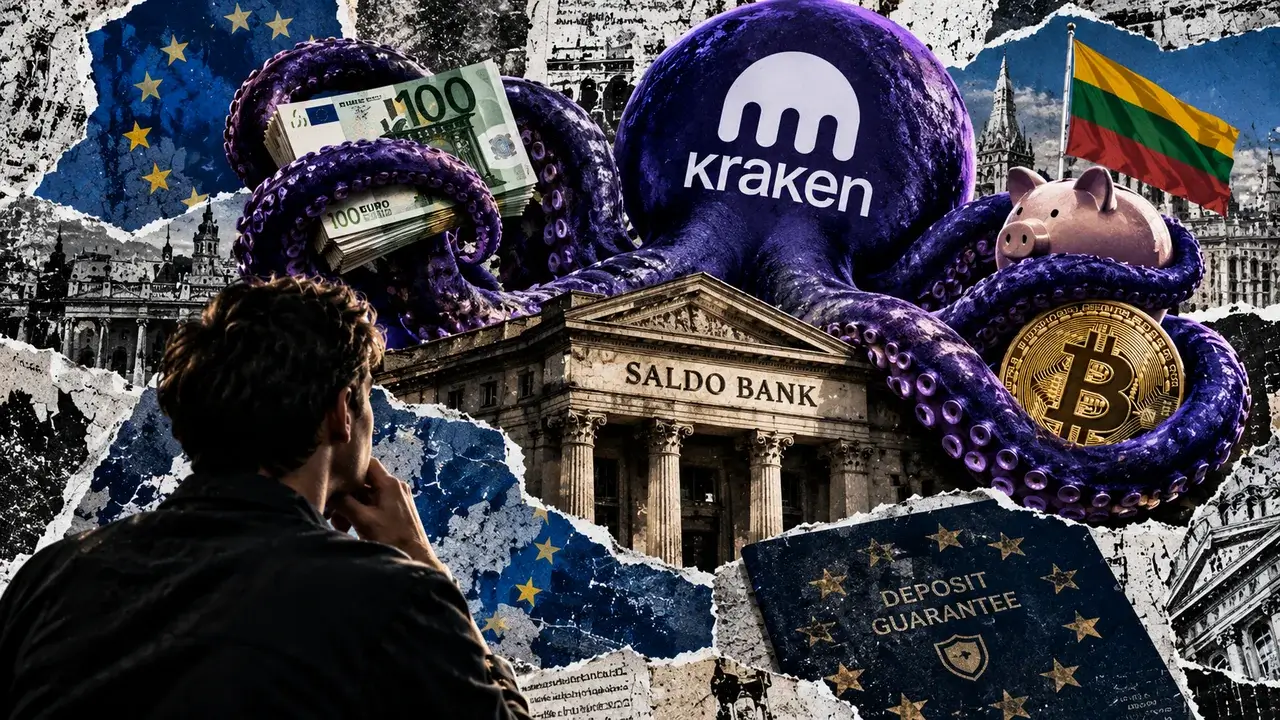
Kraken's parent company Payward has announced plans to acquire Saldo Finance Oy, the owner of Lithuania-based Saldo Bank. Once closed—likely in 2027 pending regulatory approval—the deal would bundle deposit accounts, lending services, and payment infrastructure directly alongside Kraken's cryptocurrency trading platform. For European users accustomed to keeping their banking and crypto lives separate, this convergence raises a deceptively important question: if something goes wrong, who actually protects your money?
The answer depends entirely on what kind of asset you're holding and in which legal entity it resides. Funds deposited into Saldo Bank benefit from Lithuania's deposit guarantee scheme, which covers up to €100,000 per depositor per institution—a standard across EU member states under the Deposit Guarantee Schemes Directive. However, e-money balances held under Payward Ireland Limited fall outside this insurance umbrella. Instead, they are subject to safeguarding requirements, which mandate that client funds be held in segregated accounts or backed by qualifying assets, but offer no guaranteed payout in an insolvency scenario.
The distinction becomes stark when you trace a typical user journey: a monthly salary arrives in the Saldo Bank deposit account (insured), gets converted to a stablecoin via the Kraken interface (e-money safeguarding applies), and then swapped for Bitcoin (no deposit protection, full market risk). Each step crosses a regulatory boundary, yet the user experience remains seamless. This is precisely the concern European supervisors have been flagging as MiCA's full framework beds in.
Saldo Bank's own financials add another layer of scrutiny. Loans overdue by more than 90 days nearly doubled in 2025, and credit impairment expenses outpaced operating profit, resulting in a net loss. Payward's vision of integrated consumer and business lending, card products, and institutional banking services is ambitious, but it inherits a loan book with visible stress.
From a regulatory standpoint, the acquisition does not create any cross-subsidisation guarantees between subsidiaries. Common ownership is not common liability. European users who migrate their financial lives into a unified Kraken app should map precisely which entity holds their assets at each moment—and which protective regime applies. MiCA has made Europe one of the most structured crypto jurisdictions globally, but gaps between banking law, e-money regulation, and crypto custody rules remain very real.
Keywords: Kraken, MiCA, deposit protection, e-money regulation, crypto banking
Source: cryptoslate.com