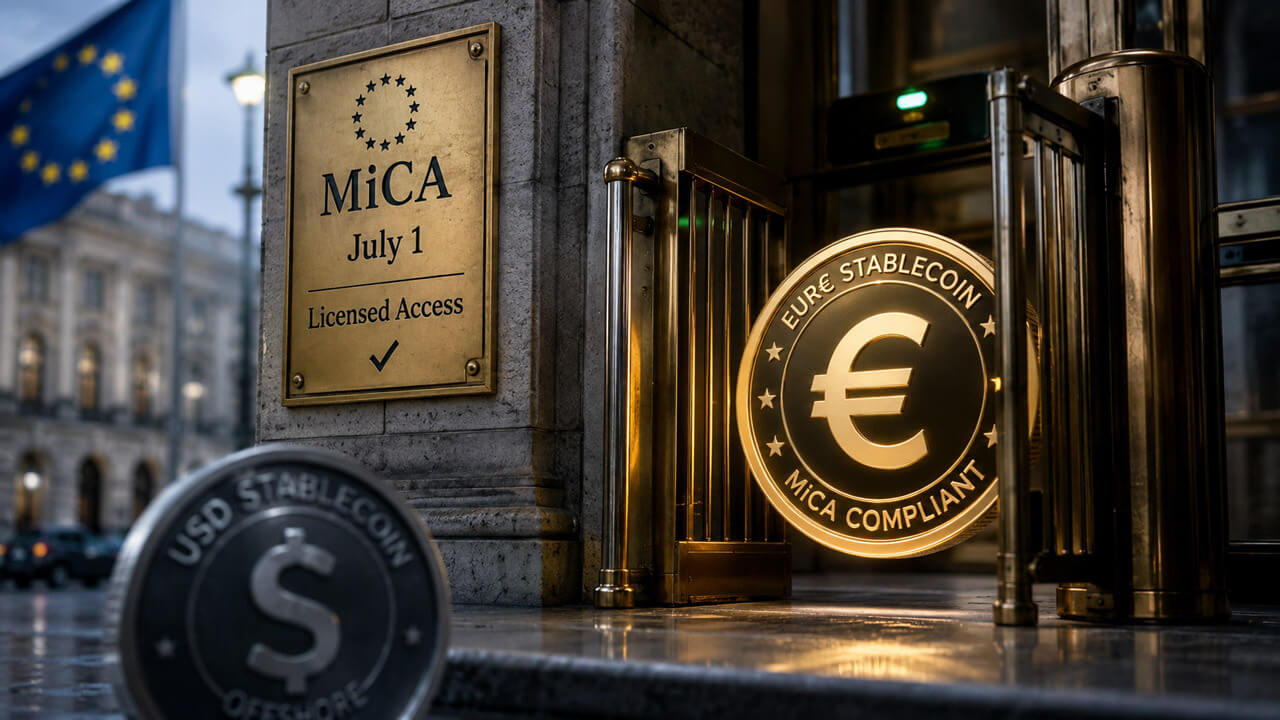
MiCA's July 1 compliance deadline has passed — and Europe's most consequential stablecoin shift is not the tokens that disappeared, but the banks that moved in to replace them. Traditional European financial institutions are leveraging MiCA authorization to assume control over stablecoin distribution channels, turning regulatory compliance into a structural market advantage.
For investors operating in Swiss and EU markets, this development reframes the MiCA conversation. The question is no longer simply which stablecoins are permitted — it is who controls the infrastructure through which investors can access those tokens. The answer, increasingly, is traditional banks.
The speed of institutional entry into stablecoin markets post-MiCA authorization is notable. Crédit Agricole launched EURXT, a euro-denominated token backed by the bank's own balance sheet and designed to integrate with institutional settlement workflows. Germany's DZ Bank followed with meinKrypto, embedded directly into cooperative banking apps and targeted at the bank's existing retail customer base.
Both products share a common strategic logic: use existing banking relationships, regulated custody infrastructure, and settlement access to build crypto products that crypto-native competitors cannot replicate without equivalent licenses. The moat is not technical — it is regulatory and distributional.
The compliance pathway MiCA created was designed to protect consumers. Its secondary effect is concentrating stablecoin distribution inside institutions that already control the payment rails European users rely on daily.
The second major consequence of MiCA implementation is the restriction of dollar stablecoin access. Revolut's announcement of USDT phase-out for European users is the highest-profile example, but it reflects a platform-level compliance decision that other regulated services are facing simultaneously.
This matters for European investors who use USDT as their primary liquidity bridge between fiat and crypto markets. USDT remains available globally, and offshore platforms are not subject to MiCA jurisdiction — but the friction of routing through non-EU regulated platforms carries compliance risk and operational complexity that most retail investors prefer to avoid.
The structural advantage that MiCA creates for authorized institutions operates across three layers. First, existing customer relationships give banks a ready distribution channel that crypto-native firms cannot access without equivalent trust and regulatory standing. Second, regulated custody frameworks — already familiar to retail banking clients — remove the friction of self-custody that limits crypto adoption. Third, interbank settlement pathways give bank-issued stablecoins integration with conventional payment infrastructure that no crypto-native token can match.
Together, these create what analysts have termed the "compliance plus distribution" moat. Once a bank establishes this position within its customer base, the switching cost for users to move to alternative stablecoin providers becomes significant.
European investors now face a genuine bifurcation. Those who remain within MiCA-compliant ecosystems gain the consumer protections MiCA provides — but accept bank mediation of their stablecoin access, with the fees, KYC requirements, and potential restrictions that entails. Those seeking to maintain USDT liquidity or access to dollar-denominated yield must navigate increasing platform friction and regulatory uncertainty.
Neither path is frictionless. The compliance-focused route trades permissionless access for institutional trust. The offshore route preserves access to global liquidity but requires navigating a narrowing set of regulated entry and exit points. The practical consequence is that Europe's crypto users are making this choice now — not as an abstract policy question, but in their platform and wallet selection decisions.
Switzerland's regulatory environment under FINMA maintains distinct frameworks from EU MiCA, but Swiss crypto businesses operating in EU markets cannot ignore MiCA's extraterritorial reach. Distribution access into EU customer bases increasingly requires either MiCA authorization or partnership with authorized institutions — precisely the distribution moat that banks are establishing now.
For Swiss investors monitoring this shift, the key variable is whether bank-mediated euro stablecoins develop sufficient liquidity depth to serve institutional trading workflows, or whether dollar stablecoin liquidity migration offshore creates a two-tier market that complicates compliance for cross-border operations. That question will define European crypto market structure for years ahead.
Keywords: MiCA, stablecoin, European regulation, EURXT, USDT, DZ Bank, Credit Agricole, euro stablecoin
Source: CryptoSlate