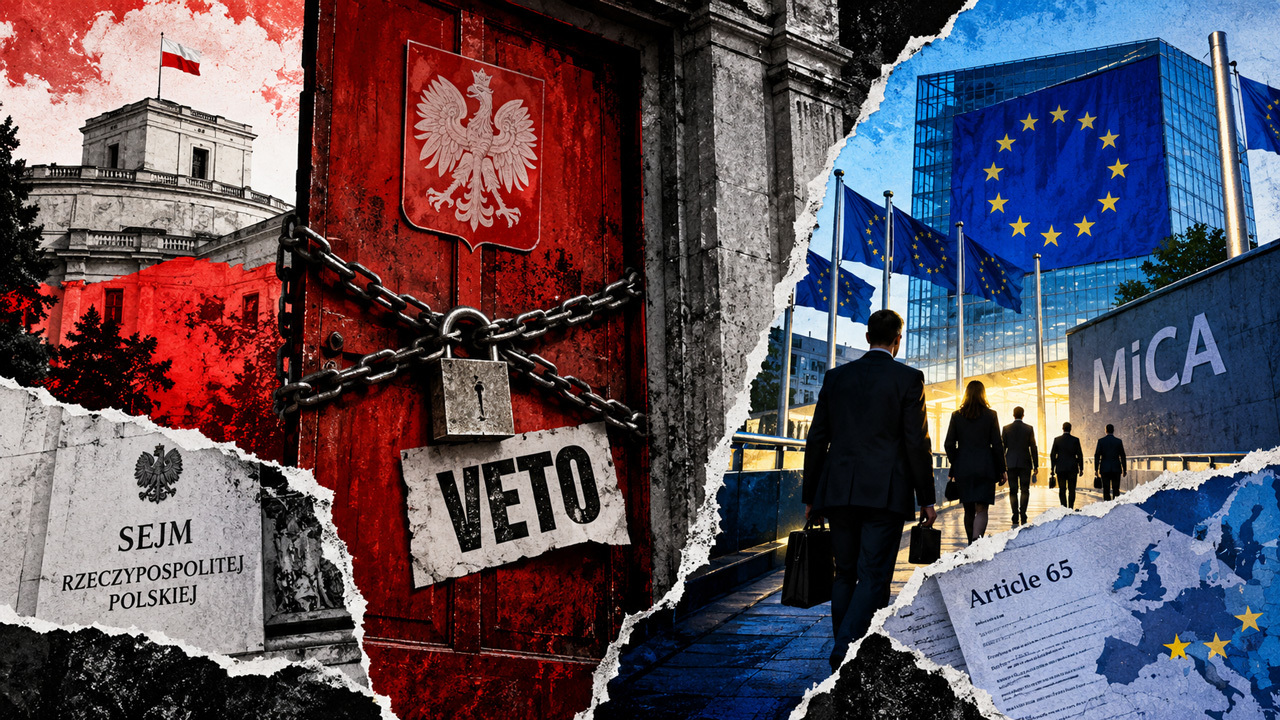
Poland's failure to transpose MiCA into domestic law has created one of the regulation's most visible fault lines: foreign EU-authorized crypto firms can enter the Polish market freely through the passporting mechanism, while locally domiciled companies cannot even initiate a licensing application. From a regulatory architecture standpoint, this is not merely a political delay — it is a structural competitive distortion that MiCA's drafters explicitly sought to eliminate.
The legislative sequence is worth examining precisely. President Nawrocki vetoed Poland's MiCA implementation bill on June 11, 2026. When the Sejm attempted to override the veto on September 4, the effort fell short at 241 votes against a required supermajority threshold. MiCA's EU-wide transition deadline expired on July 1 — meaning Poland entered a regulatory vacuum while the override vote was still pending. The result: a jurisdiction of 38 million consumers with no functioning domestic licensing authority and no legal pathway for new entrants to operate under the new framework.
The passporting provision under MiCA allows any crypto-asset service provider (CASP) authorized in one EU member state to notify regulators in other member states and begin offering cross-border services. For Poland's situation, this creates an asymmetry that mirrors patterns seen in traditional financial services before the single market was fully consolidated. A firm licensed in, say, the Netherlands or Lithuania can legally serve Polish retail clients today. A Warsaw-based firm cannot apply for the equivalent license because no Polish authority has the mandate to process such applications.
Poland's Katowice Tax Administration Chamber confirmed the previous virtual-currency register "no longer provides authorization" — closing the legacy compliance pathway before the replacement framework became available.
This is precisely the scenario that informed pan-European regulatory observers anticipated when member states began signaling MiCA implementation delays in early 2026. The regulation is designed to replace a patchwork of national regimes with a unified framework, but the harmonization benefit depends entirely on synchronized transposition. A partial implementation map — where some jurisdictions are live and others remain in limbo — does not produce a single market. It produces arbitrage.
The logical response for Polish crypto businesses is straightforward, if operationally costly: establish an affiliate or subsidiary in a cooperating EU member state, obtain authorization there, then passport services back into Poland. This pathway is legally sound under MiCA's current text. It also represents precisely the kind of regulatory flight that Warsaw's delay has structurally incentivized.
For institutional investors and compliance officers operating across European markets, Poland's deadlock carries a practical due diligence implication. Any CASP claiming to operate in Poland under legacy registration should be treated as operating without a valid regulatory mandate. The compliant counterparties serving Polish clients are, by definition, those holding MiCA authorization from another EU competent authority.
The situation also raises a broader policy question that extends beyond Poland. MiCA was designed with the assumption that member states would transpose in good faith and on schedule. The regulation's passporting architecture presupposes functioning national competent authorities on both sides of a cross-border notification. When one jurisdiction's authority does not exist — as is currently the case in Poland — the notification chain breaks down, and enforcement becomes a grey area. European regulators, including ESMA, have not issued formal guidance on this edge case.
A credible resolution requires either a renewed legislative push in the Sejm — this time with sufficient votes for passage — or an emergency executive measure to designate a transitional competent authority. Neither path has a confirmed timeline. Until Warsaw resolves the impasse, Poland remains one of the EU's largest consumer markets effectively excluded from MiCA's harmonized framework, with competitive advantages flowing to foreign-licensed operators rather than domestic industry participants. For European crypto market observers, it is a case study in what regulatory fragmentation looks like when harmonization legislation meets uncoordinated national political cycles.
Keywords: MiCA, Poland crypto regulation, EU crypto licensing, crypto passport, regulatory arbitrage, European crypto law, MiCA implementation, crypto compliance Europe
Source: CryptoSlate