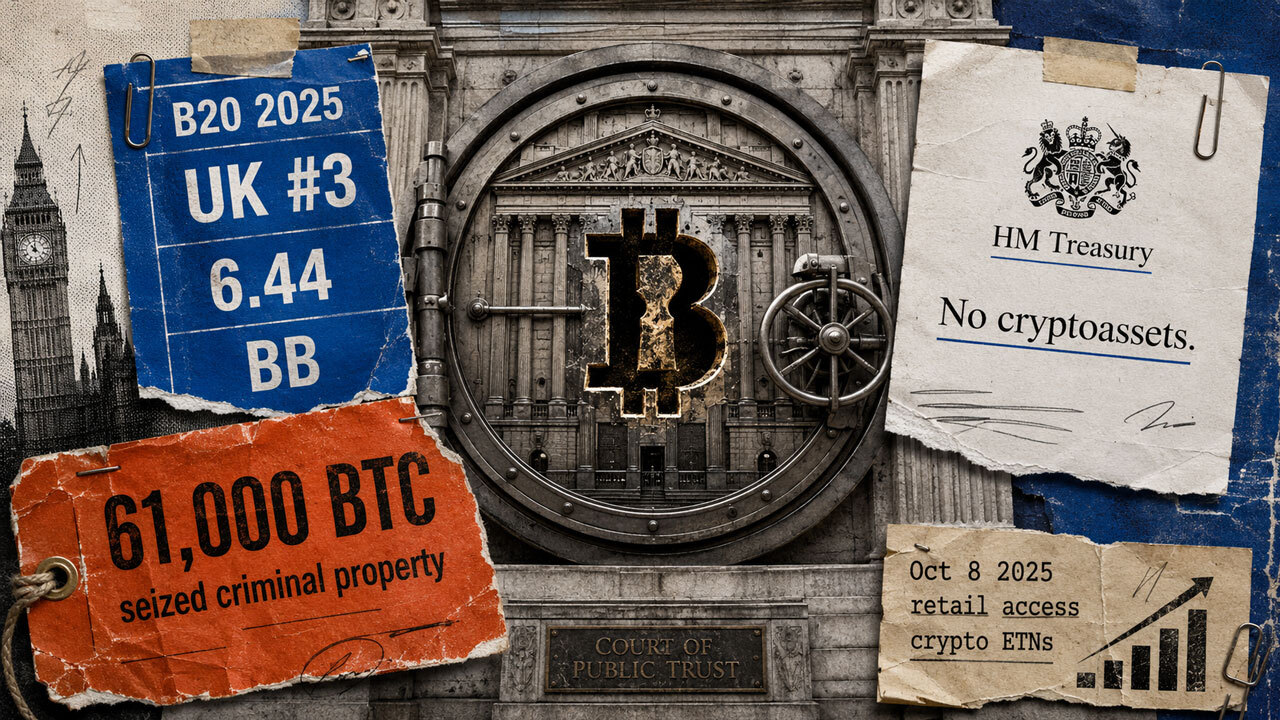
The United Kingdom holds more than 60,000 Bitcoin in law-enforcement custody, yet under current court proceedings those coins remain classified as seized criminal property — not a sovereign reserve. That legal boundary sits at the heart of a striking disconnect: JAN3 just ranked the UK third in its 2025 B20 Bitcoin adoption index, while the Treasury explicitly states it holds no cryptoassets.
The B20 scorecard, published by JAN3 this month, assigned the UK a score of 6.44 and a BB rating. The United States leads at 7.42, followed by Bhutan at 6.64. Britain's ranking reflects a composite picture spanning regulatory posture, legal-tender treatment, strategic-reserve policy, and the extent to which Bitcoin can be used in ordinary economic activity — not a single, decisive government commitment.
JAN3's framework rewards multiple dimensions of state-level Bitcoin engagement simultaneously. A nation scores points for holding Bitcoin, state mining operations, favourable legal and tax treatment, strategic-reserve declarations, and pro-Bitcoin political leadership. Britain's 6.44 is driven in large part by the volume of BTC in Crown custody — roughly 61,000 coins seized in a major investment fraud and money laundering case — combined with recent regulatory access milestones.
The scorecard rewards several kinds of engagement under one score. Britain's 6.44 combines regulation and access with enforcement custody, while its dated official reserve policy remained separate from the large seized balance.
UK asset-recovery law treats seizure as a temporary custodial step while court proceedings run their course. Once a confiscation order is issued, proceeds may be distributed to compensate victims or directed to the public purse and economic-crime enforcement funds. The Crown Prosecution Service described the 60,000-plus BTC as alleged criminal property, and confirmed that both confiscation and civil proceedings will determine its final disposition.
For European investors watching sovereign Bitcoin strategies, the UK case illustrates how a country can rank highly on a composite adoption index without committing to a treasury position. The distinction matters: enforcement custody inflates a nation's apparent BTC holdings on paper, but those coins carry legal risk and cannot be deployed as a reserve asset without a fundamental change in policy and court outcomes.
The UK's broader regulatory roadmap remains in construction. The government has signalled that its comprehensive crypto regulatory regime will begin in 2027. Until that framework is in place, institutional market participants face a patchwork of FCA rules, property-law updates, and unresolved reserve-policy questions. The B20 ranking captures where the country stands today — not where its Bitcoin policy will land.
The index serves as a useful benchmark for comparing national postures, but investors should read it alongside the underlying legal architecture. A third-place ranking built substantially on seized criminal assets is categorically different from one built on deliberate sovereign accumulation — and the distinction will matter enormously when confiscation proceedings conclude.
Keywords: UK Bitcoin, Bitcoin adoption, JAN3 B20, Bitcoin reserve, seized Bitcoin, UK crypto regulation, Bitcoin ETN, Europe crypto policy
Source: CryptoSlate